For staffing firms

Your compliance desk shouldn't live in an inbox.

A certificate of insurance arrives at eleven at night. Somebody reads it in the morning, checks it against a rule that lives in their head, and chases the missing endorsement across three threads. The partner waits a week to receive its first requisition, and the exposure sat in your inbox the whole time with your name on it.

We build the desk that reads, decides, and keeps the receipts, and then we keep it correct after launch. Subvendor compliance, requisition distribution, and the placement lifecycle. AI reads, code decides, people handle the exceptions. Two of these systems already run in production, for the same firm.

What a staffing operation runs into

Your compliance desk lives in an inbox.

Certificates of insurance, W-9s, banking, MSAs: read by a person, checked against rules held in someone’s head, chased across threads. A missed document is a compliance exposure with your name on it.

Subvendor onboarding is a bottleneck, not a gate.

Every new partner is a manual review before they can receive a single requisition. The queue is the constraint on how fast your supply chain can grow.

Double-submits and margin leaks are caught late, by people.

Two vendors submit the same candidate. A bill rate reaches a place it should never go. The controls that should be structural are memos someone has to remember.

What we build instead

  1. 01

    AI reads the documents

    Classification and vision extraction pull the facts off every COI, tax form, and agreement. The model reads; it never decides.

  2. 02

    Code issues the verdict

    A deterministic rule engine renders the compliance decision the same way every time. Anything ambiguous or low-confidence routes to a human-review queue with the evidence attached.

  3. 03

    The supply chain runs on rails

    Requisitions release only to vetted partners. Placements ride an append-only event spine with a hard candidate-ownership lock. A margin firewall keeps every bill rate out of the portal and out of every model prompt.

  4. 04

    Everything is governed and owned by you

    Row-level security on every table, a full audit trail, human approvals bound to exact content hashes, e-signature on production. The code, the infrastructure, and the playbook are yours.

Two systems we run for a staffing firm

The client stays unnamed. The work is real, in production, and receipted. Open either case study for the full build.
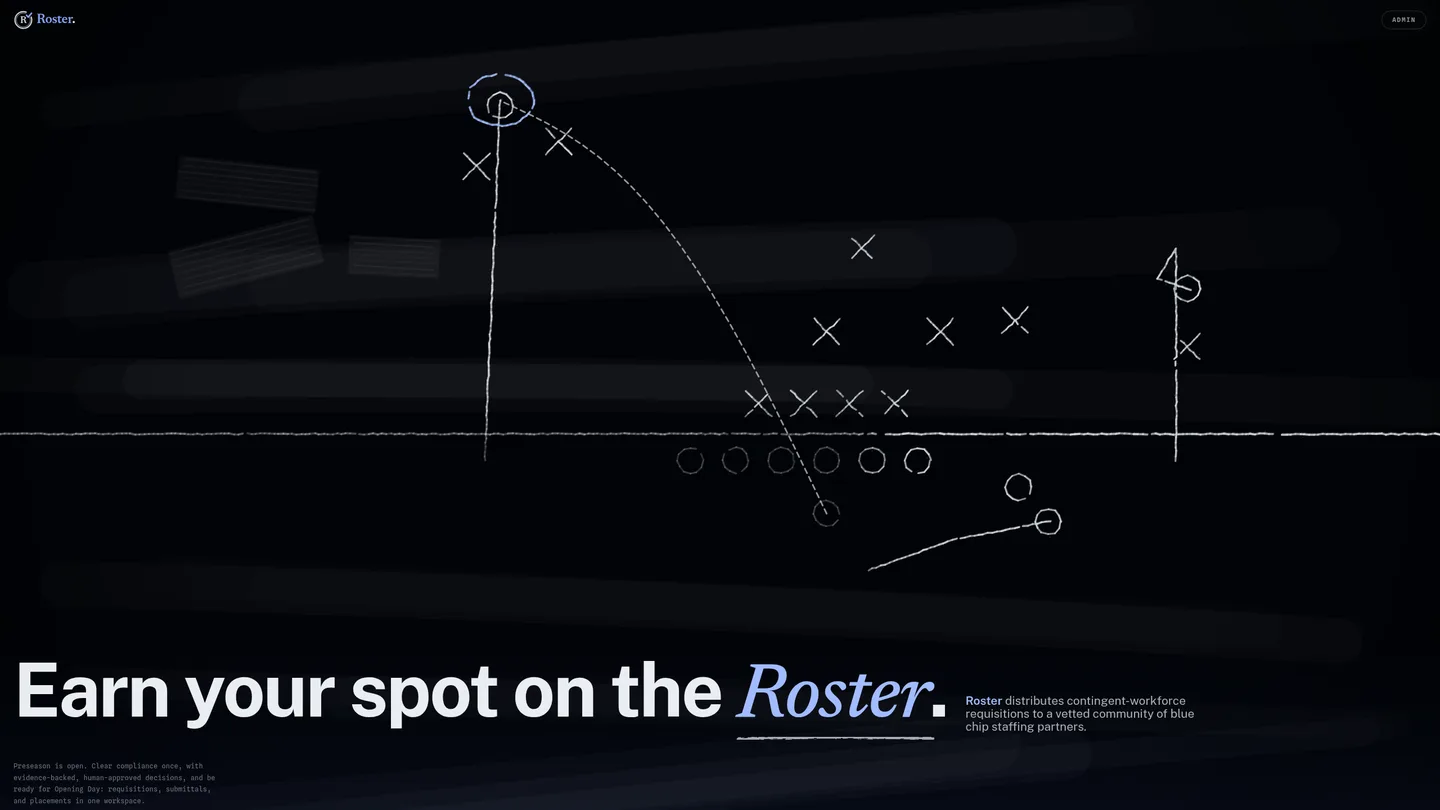
The subvendor marketplace splash: a chalk play diagram with the line, earn your spot on the Roster.

The compliance marketplace

Requisitions release only to vetted partners. AI reads the insurance, tax, and banking documents; a deterministic rule engine issues the verdict; a human approves; the agreement e-signs in production.

~5 s email to decision·106k requests, zero failures·1,160 tests gating CI
Open the case study →
The agent platform's public face: a photoreal iris over black with the line, I watch the whole firm.

The agent platform behind the desk

Specialist agents for finance, recruiting, sales, and account intelligence, under an apex that sees the whole firm. Governance is mechanical: views-only reads, row-level security everywhere, approvals bound to content hashes.

seven agents·1,209 runtime tests·94 governed tables
Open the case study →

One number, and the number behind it

Time from a document landing to a compliance decision. On the marketplace we run it is ~5 s on the compliance plane, measured end to end. The number you will feel is the one behind it: how many days a new partner waits before it can receive its first requisition. A desk that decides in seconds and routes only the ambiguous cases to a person turns that wait from a queue into a gate, and the gate keeps a receipt for every partner it opened or held.

Build it, then keep it correct

The workshop

Four hours. Fifteen seats. $500 a seat. Your own compliance inbox on the table. Everyone leaves with one workflow automated on their own laptop, the list of the three that eat the most hours in your operation, and a real read on what a desk would cost. It is the cheapest way to find out whether this is for you, and the first one is being scheduled now. Ask for a date.

Running a voice agent on your intake or answering line as well? The same discipline behind these systems ships as a fixed-price Voice Agent Production Readiness Audit.

Questions staffing operators ask

What does a staffing compliance desk look like when it runs on this?

A subvendor sends its documents by email or portal. AI reads the certificate of insurance, the tax form, the banking letter, and the agreement, and extracts the facts. A deterministic rule engine renders the compliance verdict the same way every time, with the evidence attached. Anything ambiguous routes to a person. Cleared partners receive requisitions; nobody else does. Every decision, approval, and release is a row you can audit.

Do you build it, or run it?

Both, in that order. The desk is a fixed-price build: the AI Document Pipeline at $14,500 for the compliance plane, or the Agent Platform Build from $25,000 when the back office comes with it. After launch the Production Operations Retainer, from $3,500 a month, keeps it correct: watchdogs on the seams, a receipt on every action, a nightly reconcile, a monthly report. Or your team takes the playbook and owns it; the code and the infrastructure are yours either way.

What is the outcome I can measure?

Time from a document landing to a compliance decision. On the marketplace we run, that is about five seconds on the compliance plane, measured end to end and receipted. The number you will care about is the one behind it: how many days a new partner waits before it can receive its first requisition. The desk turns that from a queue into a gate.

What stays out of the model?

Bill rates and margin. A margin firewall keeps every rate out of the portal and out of every model prompt, in code rather than in a policy. The model reads documents; it never sees the money and it never decides.

Can our vendors game it?

Two vendors submitting the same candidate is caught by a hard ownership lock on an append-only event spine, not by a person remembering. A document that does not meet the rule routes to review with the reason attached, so a vendor cannot argue with a black box; they can read exactly which requirement failed.

What is the workshop?

Four hours, fifteen seats, $500 a seat, your own compliance inbox on the table. Everyone leaves with one workflow automated on their own laptop, a list of the three that eat the most hours in your operation, and a real read on what a desk would cost you. Dates by request while the first one is being scheduled.

If your operation is drowning in documents, this is the team.

Thirty minutes on your workflow, free. You leave with direction whether or not you hire us.

Receipt

Verified
How it's measured
What it doesn't claim

No receipt, no number. Every figure on this site resolves here.